Perception 9 - It's all about your Perception: Space
Showing posts with label Space. Show all posts

Thursday, February 2, 2023

Comet C/2022 E3 (ZTF): A Celestial Phenomenon Worth Observing

February 02, 2023 0
Comet C/2022 E3 (ZTF): A Celestial Phenomenon Worth Observing

Comet C/2022 E3 (ZTF)


Comet C/2022 E3 (ZTF) is a celestial object that is attracting a lot of attention from astronomers and sky-gazers around the world. This comet was first discovered on March 8, 2022, by the Zwicky Transient Facility (ZTF), which is an optical and near-infrared sky survey project that operates at the Palomar Observatory in California. Since its discovery, this comet has been observed by astronomers all over the world, who are keen to study its trajectory and physical properties.

Comet C/2022 E3 (ZTF) is a short-period comet, meaning that it orbits the Sun in less than 200 years. Its orbit is highly elliptical, and it will approach the Sun at a distance of about 0.08 astronomical units, which is roughly equivalent to the distance between the Earth and the Sun. This means that it will be relatively close to the Sun, and it is expected to be highly active, producing a bright tail and a distinctive coma, which is the cloud of gas and dust that surrounds the comet's nucleus.

One of the most exciting things about Comet C/2022 E3 (ZTF) is that it will be visible from Earth during the northern hemisphere's summer, making it an excellent target for amateur astronomers. It is expected to be visible to the naked eye, and will be particularly visible during the early morning hours, before dawn. This is because the comet will be passing close to the Sun, and will be in the sky just before sunrise. For those who are interested in observing the comet, it will be located in the constellation of Draco, and it is recommended that you use binoculars or a telescope to get a better view.

In addition to being visible from Earth, Comet C/2022 E3 (ZTF) is also of great scientific interest. Astronomers are keen to study its orbit and physical properties, as it will provide new insights into the formation and evolution of comets. The study of comets is crucial in understanding the early solar system and how the inner planets were formed. In addition, comets contain valuable information about the chemical composition of the solar system and the processes that led to the formation of life on Earth.


Another important aspect of studying Comet C/2022 E3 (ZTF) is that it provides a unique opportunity to study the effects of the Sun's radiation on a comet. As the comet approaches the Sun, it will be exposed to intense heat and radiation, which will cause it to release large amounts of gas and dust into space. This will provide valuable data on how comets react to solar radiation, which is essential for understanding the role that comets may have played in the formation of life on Earth.

In conclusion, Comet C/2022 E3 (ZTF) is a celestial object that is attracting a lot of attention from astronomers and sky-gazers around the world. It is a short-period comet that will be visible from Earth during the northern hemisphere's summer and is expected to be highly active, producing a bright tail and a distinctive coma. It is also of great scientific interest, as it provides a unique opportunity to study the effects of the Sun's radiation on a comet and to learn more about the formation and evolution of comets. Whether you are an astronomer or simply a sky-gazer, be sure to keep an eye out for Comet C/2022 E3 (ZTF) this summer!

Thursday, December 15, 2022

The Science of Time Dilation: How it Affects Space Exploration

December 15, 2022 0
The Science of Time Dilation: How it Affects Space Exploration


Time dilation is a phenomenon that occurs when objects are in motion relative to each other. Essentially, time passes at different rates for objects in different states of motion, leading to the phenomenon of time dilation.


This concept is a crucial component of the science of space exploration, as it has significant implications for the accuracy of space missions and the overall success of space exploration endeavors.


In the context of space exploration, time dilation is observed when a spacecraft is traveling at a high speed relative to an observer on Earth. As the spacecraft moves at a faster rate, time appears to pass slower on the spacecraft relative to the observer on Earth.


For example, the twin paradox is a well-known example of time dilation in space exploration. In this scenario, two identical twins are separated, with one twin traveling on a spacecraft at near-light speed while the other remains on Earth. Upon the spacecraft twin's return, the twin on Earth will have aged significantly more than the twin on the spacecraft.


This phenomenon has important implications for the accuracy of space missions. For instance, the Global Positioning System (GPS) relies on highly accurate clocks to provide precise positioning data. However, due to time dilation, the clocks on GPS satellites experience a time difference relative to clocks on Earth, which must be accounted for in order to maintain accuracy.


Additionally, time dilation affects the aging of astronauts on long-term space missions. As a result, space agencies must take time dilation into account when planning and executing space exploration missions.


In conclusion, time dilation is a fundamental aspect of the science of space exploration. Its effects on the accuracy of space missions and the aging of astronauts must be carefully considered in order to ensure the success of space exploration endeavors.

Sunday, March 4, 2018

5 Unsolved Mysteries of Space that will Blow Your Mind

March 04, 2018 0
5 Unsolved Mysteries of Space that will Blow Your Mind
It's a dependable fact that space is loaded with puzzles. 

How about we take an excursion through probably the most intriguing puzzles of the universe. 


1. Jupiter's Great Red Spot


The most effective typhoons at any point recorded in our planet's history crossed over a thousand miles with twists blasting up to 200 miles for each hour. 

That is sufficiently wide to extend crosswise over about the greater part of the US states east of Texas. 

Nonetheless, even that sort of tempest is predominated by the Great Red Spot, a tremendous tempest on Jupiter's surface. 

With twists cresting at an expected 400 miles for every hour, the Great Red Spot has been whirling fiercely finished Jupiter's skies for a few centuries. 

The most punctual record of this marvel goes back to the 1600s yet it is as yet hazy what's behind the Great Red Spot. 

Be that as it may, there is a purpose behind this. Jupiter is a thousand times as large as the Earth and it comprises for the most part of the gas, a fluid sea of hydrogen that encompasses its center and the climate comprises of hydrogen and helium. That converts into no strong ground like we have on our planet. 

Over that, Jupiter's mists impede clear perceptions of its lower air. On account of circling tests and telescopes considering this monstrous planet, we trust we know bounty about Jupiter's upper air and its concoction components. 

Be that as it may, researchers don't know precisely how or considering whether these chemicals respond to give hues like those in the immense red spot. All things considered, this planet is altogether different from our own and it is fascinating to know the motivation behind why and how this enormous red tempest has figured out how to exist for more than 400 years now. 


2. Dark Energy


A puzzling amount known as Dark Energy is accepted to make up about three-fourths of the universe. 

However, researchers are uncertain what it is as well as how it works. The main thing we know today is that dull vitality exists. 

In 1929, American stargazer Edwin Hubble contemplated detonating stars known as Supernova to establish that the universe is extending. From that point forward, researchers and stargazers have tried to decide exactly how quick. 

In the 1990s, two autonomous groups of astrophysicists found that the extension of the universe isn't backing off rather it is accelerating. This implies something must balance gravity and that something is the thing that we call dull vitality. 

Knowing how dull vitality influences the spreading universe can just tell researchers to such an extent. The properties of the obscure amount are as yet a puzzle. 

The main hypothesis, be that as it may, considers dull vitality a property of room. Albert Einstein was the first to comprehend that space was not just void. Nonetheless, even this incredible researcher conceded that it'll take some time until the point that we create advances that will open this riddle. 

Likewise, dim vitality shouldn't be mistaken for the dim issue. Like dull vitality, the dim issue keeps on perplexing researchers while dim vitality is accepted to be the power that records for the extending universe. The dull issue might be in charge of how gatherings of articles work together. 

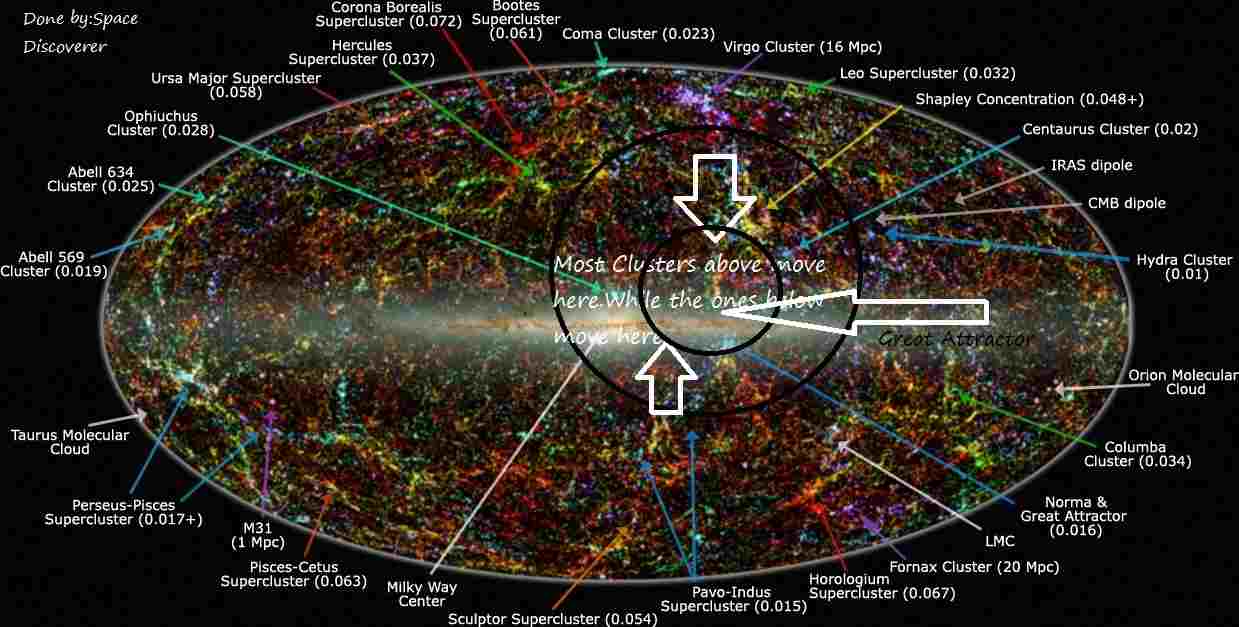
3. The Great Attractor


There's a staggeringly weird place in the universe that appears to draw in planets and items. Sadly, it's on the opposite side of the Milky Way and we can't see it. 

This is the reason researchers are endeavoring to reveal what could be doing the greater part of this pulling in. 

Our universe and other adjacent worlds are being pulled toward a particular district of room. It's an expected 150 million light-years away and we are calling it the Great Attractor. 

It lies toward a path of the sky known as the zone of evasion. It's in the general bearing of the focal point of our world where there is so much gas and clean that we can't see it obviously. What we know is that our system and other close-by universes are advancing toward the Great Attractor which implies that something is causing this response. 

That implies either there must be something gigantic out there or it's because of something considerably more weird and strange. 

Despite the fact that we anticipate that something huge is pulling our cosmic system, it appears as though there's something significantly greater out there since even the Great Attractor is being pulled in by something many refer to as the Shapley Supercluster. 

Extremely whatever we can construe now is this, the Great Attractor may not by any stretch of the imagination be a thing, however, a place, the point of convergence of our fix of the universe. 

Normally, some of you may reason that our planet will be demolished by the Great Attractor sooner or later. In any case, it's not trusted this can happen and that is a direct result of dim vitality and it's obscure impact that keeps our cosmic system from being devastated. So regardless of its unpropitious name, the dull issue isn't that unsafe all things considered. 


4. Black Holes


A Black Hole in space is the thing that structures when a star of enormous size breakdown. 

One of the fundamental qualities of a dark gap is the huge energy of its gravitational force. The force is strong to the point that nothing can escape it not in any case light. 

On the off chance that a star draws nearer to a dark gap, it will be assimilated and won't re-develop. 

The presence of dark gaps was first recommended in the late eighteenth century. In any case, it wasn't until 1967 that American physicist John Wheeler alluded to this fall mass as a dark opening. 

Strangely enough, we can't see a dark opening since it's undetectable. The nearness of a dark gap must be recognized by the impact it has on the articles around it since it draws in them. 

Obviously, we don't comprehend what happens when a dark gap assimilates a star. We aren't sure if that star returns elsewhere in the universe or on the off chance that it gets wrecked. What we do know is that dark openings can turn out to be huge in measure subsequent to retaining various articles. Truth be told, a supermassive dark gap is situated in the focal point of our universe. 

One thing is certain, dark gaps are unimaginably elusive and to ponder. 

For instance, the Cygnus X1 is a body in space that has been contemplated since the mid-1960s. Indeed, even following 50 years, we trust that we have discovered a dark opening yet we're not a hundred percent certain. As said previously, this isn't a question that can be seen similarly a star or a planet could be. 

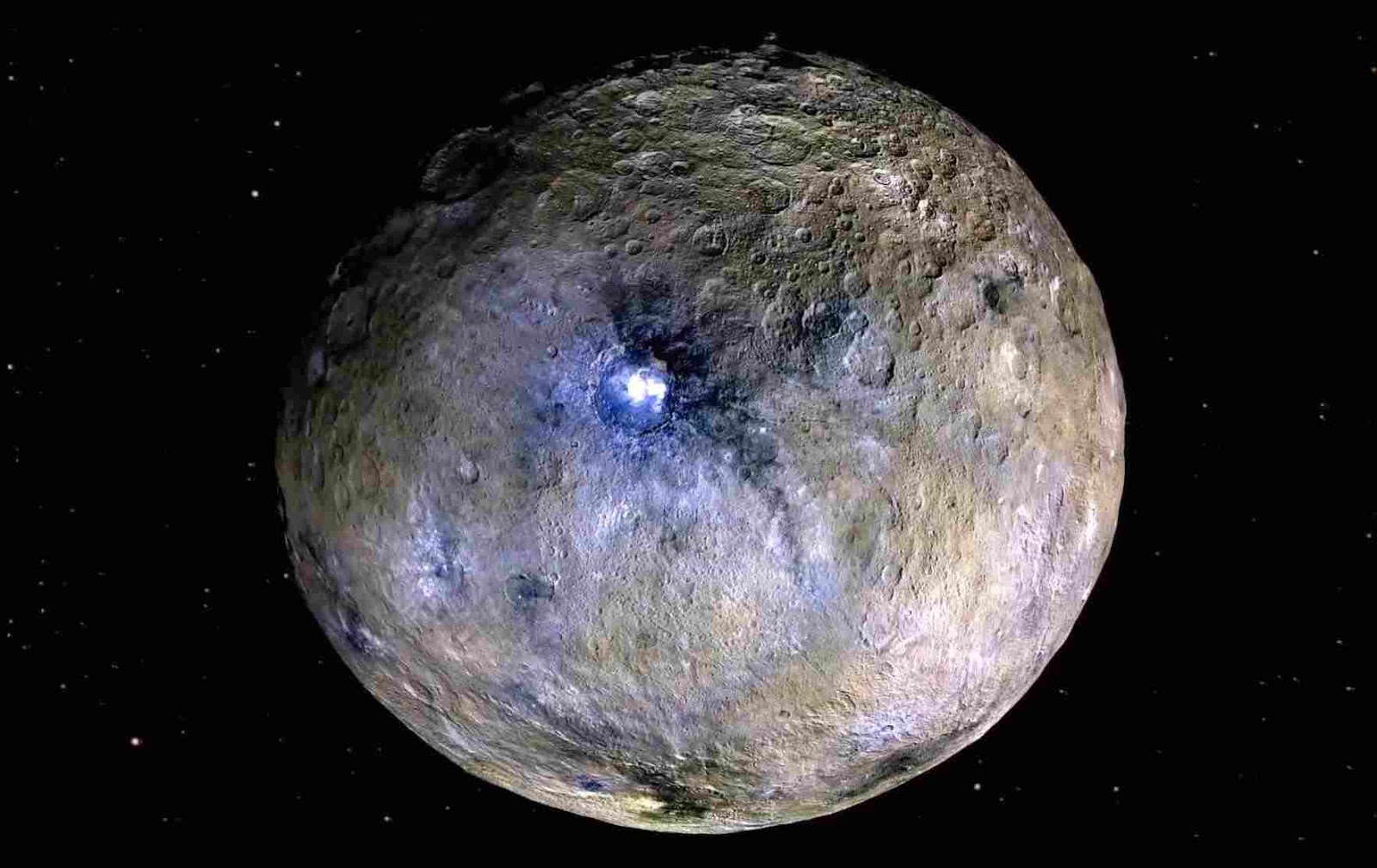
5. The Mysterious Pyramid on Ceres


In 2015, we got new pictures from a puzzling midget planet called Ceres otherwise called arrangement in English. 

The staggering pictures were taken by the Dawn shuttle which was sent to the space rock belt amongst Mars and Jupiter. This authentic accomplishment brought about finding the shuttle on Ceres. This is the means by which we found out around two of the most perplexing highlights found on this planet. 

Those are its puzzling brilliant spots and a pyramidal molded structure. 

The outsider pyramid as it's been named by some is in certainty called Ahuna Mons. From Earth, this structure resembled a pyramid on the surface of the midget planet. As the daybreak shuttle circumnavigated Ceres and much lower elevations, the correct state of this pyramid came into the center. 

Today, we realize that Ahuna Mons resembles a vault with smooth soak dividers. Researchers say that on its steepest side, Ahuna Mons rises four miles in stature yet the structure is as yet an awesome secret. 

Around four hundred miles northwest of Ahuna Mons lies the now acclaimed Occutor pit with its puzzling and secretive brilliant lights. Researchers are as of now expressing that the strange splendid lights are caused by a kind of magnesium sulfate. An alternate sort of magnesium sulfate can be found on earth and it's called Epsom salts. 

UFOlogists have an altogether different feeling. They assert that the cavity is loaded with strange structures that are definitely not common arrangements. A few Ufologists are stating that few structures can be seen alongside the brilliant and sparkly spots. Despite what truly scientists have not possessed the capacity to clarify the secretive shapes and splendid spots. 

What do you think about these mysteries? 

Don't hesitate to impart your insights in the remark area beneath. 

In the event that you think that it's fascinating and on the off chance that you think that it's strange, share this article. 

Additionally, make certain to subscribe to our newsletter since you would prefer not to miss what's coming straightaway.

Monday, February 26, 2018

The Moons Water May Be Widespread And Immobile - Says NASA

February 26, 2018 2
The Moons Water May Be Widespread And Immobile - Says NASA
The recent study of the data from two moon missions pinpoints the proof that water of the moon is greatly dispersed across the surface is not limited to a particular region.


This finding from the study can help the researchers of NASA to understand how the water on Moon originated and if it can be used as a resource for future exploration programme. If so, then the future explorers can use it as drinking water, convert it into Hydrogen and Oxygen for the rocket fuel and Oxygen to breathe.

According to Joshua Bandfield "We find that it doesn’t matter what time of day or which latitude we look at, the signal indicating water always seems to be present. The presence of water doesn’t appear to depend on the composition of the surface, and the water sticks around".

Percept More:


The result which was similar to some previous studies had suggested that the more water was found in the polar area of the moon. And the strength of water signal ups and downs according to the lunar days i.e 29.5 Earth days.

Taking these results, some researchers suggested that the water molecules can have jumped across the moon surface until they reach the cold trap of north and south poles. A cold trap is an area which is so cold that the water vapor and other variables that come into the touch with the surface will stay stable for a long period of time, maybe up to many billion years.


The talks continue because of the difficulties of how the discovery has been concluded so far. The main proof has come for remote-sensing tools which measured the power of sunlight reflected off the moon's surface. Tools like these pick up a scary fingerprint at wavelengths near 3 micrometers, that lies beyond visible light and in the world of infrared radiation.

The recent findings of widespread and quite immobile water suggest that it may be present as OH. OH, referred as hydroxyl doesn't stay long on its own.

 The researchers are still on the table-talk what the studies tell them about the origin and source of the water on the Moon. The result of the studies point toward OH/H2O might have been created by the solar wind hitting the moon's surface.

Although, the team didn't eliminate that OH/H2O could have come from the Moon itself, slowly released from deep inside minerals where it has been locked since the Moon was formed.

Source - NASA

Percept More:

Sunday, February 25, 2018

The Most Advanced Civilization In The Universe

February 25, 2018 0
The Most Advanced Civilization In The Universe


Earth and civilization as we know it has come a long way in the past 200,000 years and has experienced a multitude of changes in that time. The human species has only existed for a mere 0.0015% of the immense 13.7 billion year age of the universe. However, humanity has conquered some of the most daunting tasks in that time period. They've come from hunting and gathering in the fields of Africa, colonizing the entire planet in a time period that is relatively a blink of an eye on the cosmic level. Some of the greatest minds ever exist have helped push modern civilization forward and achieve goals that were once thought to be impossible. In just the past  150 years, we have gone from being stuck to the Earth's soil to lending to our closest cosmic neighbor the moon.

Humanity's success is nothing sort of spectacular but on the universal scale, we may be rather insignificant. What would happen if we met an advanced alien species with technology more advanced than we could ever imagine?

In 1964, a Soviet astronomer by the name of Nikolai Kardashev introduced the hypothetical scale that can be used to measure the level of a potential civilization of technological advancement based on the amount of energy this civilization can produce. And now it is known as the Kardashev scale.

Read More:

The scale has three traditional types but many extensions of modifications to the scales and proposed since its creation. The scale is logarithmic. Meaning as we go on the amount the power of the civilization has is much much more substantial. In 1964, Kardashev has defined the three base levels of civilization based on the power available to them.


Type I - The Planetary Civilization


Type I is the smallest of the original types that are also called a planetary civilization. This is no similar to our good old friendEarth. Type I civilizations are capable of storing and using all of the energy which reaches to the planet from its host star, which in our case is the Sun. This amount of energy would amount to an enormous time to the 7 trillion watts. The modern civilization here on earth so is not quite exactly fitting that the Type I civilization category.

Yes, I know. Humans can't even fit into the lowest level of the advanced civilization. Rather than fitting into a Type I civilization, we humans lined one of the extended types of civilizations, Type Zero. You see, when this scale was proposed, famous astronomer Nashville physicist Carl Sagan produced a formula to define a certain hypothetical civilization to Kardashev rating.

This is that formula.


K represents a hypothetical civilizations Kardashev rating while P represents the amount of power the civilization uses in watts.

The proposed Type 0 Civilization will control approximately 1 Megawatt or 1 million Watts of power which is miniscule compared to the amount of power we use on a daily basis. In 2015 alone, the total world energy consumption 17.35 Terawatts. Plugging this number into P and cranking out the numbers at Kardashev rating as a civilization will be approximately that to Type 0.72. Even as a civilization with 7 billion humans on our planet. 12 of which them adventure to the moon with spacecraft spent billions of miles into the abyss of interstellar space complains to colonize Mars in the near future, we still only score a measly 0.72 of the Kardashev scale.

Read More:

According to Carl Sagan, humanity is going through a phase of technical adolescence, typical of a civilization about to integrate the Type I Kardashev scale. Michio Kaku, another brilliant theoretical physicist suggests that humans may attain Type I status in the next 100 to 200years. Type II status in perhaps next few thousand years and Type III status in 100,000 to 1 million years. This really goes to show the truly immense timescales it would take to advance to the next type of civilization. However, we are heading towards becoming a Type I civilization in the next couple of hundred years or so. And this is a huge step for Humanity.

As a Type I civilization, we would have complete control over our own planet. Perhaps, we could influence the weather change, the geological makeup of our own planet and much much more. However, even this amount of power is tiny compared to the next type of Civilization

Type II - Stellar Civilization


Type II civilizations also referred to as a Stellar civilization can control the total energy of its host star and transfer the energy throughout the entire solar system. One popular hypothesized device to use to harness the entire energy output of Type II civilization so star is called Dyson structures. You may have seen these before as they are rather popular in science fiction. The name was coined by Freeman Dyson and it is essentially a system of orbiting solar power satellites. Basically, it's an insanely massive hollow sphere built around a civilization so star tune you'll call of the energy from it.

Another rather exotic idea to harness energy for a Type II civilization would be to seed a stellar mass. For example, a star into a nearby black hole and collect the photons emitted by the accretion disk. Now, how a civilization could somehow deposit a star into a black hole is beyond me. What it is the means of energy nonetheless?

Read More:

A Type II civilization would not only build these supermassive structures but would control and live within them. They would control every single planet in their solar system, mine the asteroids at their leisure and essentially do whatever they want inside the solar neighborhood. The amount of powered civilization would have is remarkable but is nothing when compared to a Type III civilization.

Type III - Galactic Civilization


The Type III civilization also referred to as a Galactic civilization can control the total energy of its entire host galaxy. The amount of power the civilization would have is truly frightening and its order in the realm of science fiction.

This civilization would function extremely similar to the way Type II civilization work. It would harness the power of stars, mine planets and asteroids and so on but not only for one star but for billions of stars. A civilization such as this would use planets and solar systems like legos building and de-constructing planets to build up their empire elsewhere in the galaxy. The galaxy would seemingly become their playground and everything they do and use is merely a toy.

Harnessing the energy of quasars would be like hitting the lottery for them. The supermassive black hole, the center of their galaxy could be used as an energy source for a Type III civilization. Galactic real-estate would become a reality with Planet, Stars or even complete solar systems being auctioned off by some supreme leader. Interestingly enough, this hypothetical galaxy may not even be noticeable if such a civilization did exist. All of the energy from these dollars would be felled and used for whatever the civilization may need. This means all the starlight, gas and element in an entire galaxy would become like your kitchen pantry. If all of the matter and their entire galaxy was exploded for energy, an outside observer would view the galaxy to be completely invisible. It would appear as if there was a hole in the galaxy or if they have colonized the entire galaxy, perhaps, nothing at all.

Read More:
Scientists Have Found Source of Mysterious Sounds from Space

There is a place in space known as the great void. At nearly 330 million light years in diameter, the great void is one of the largest known voids in the entire universe and is commonly referred to as a Supervoid. This region of space is seemingly devoid of life in galaxies as we know it. A region of space with such a massive size as the great void contained, scientists estimate there should be at least, 2000 galaxies in stereo space. But today, their volume in 60 galaxies that have been discovered in the great void. This is a mere 3% of the amounts of galaxies that should occupy an area this large. So where are they? It to be Type III civilizations completely dominating an entire region of space milking a 330 million Lightyear wide region for resources.

Leave your thoughts in the comments below and I'll be sure to respond to them as quickly as I can.

Read More on Perception 9:
What If You Fit Entire History of Earth in One Year

Saturday, February 24, 2018

What Would Happen If Earth Was.....

February 24, 2018 0
What Would Happen If Earth Was.....

What would happen if the Earth wasn't tilted


Our Earth sits on its axis at a 23.5-degree angle and it's a good thing too. This is why we have all our seasons. But what if there wasn't a tilt?

Well, first of all, the earth would definitely be a completely different place to live.  The Arctic and Antarctic regions would become more pleasant places to live in. The Sun would make an appearance every day and these regions wouldn't be so cold. You wouldn't be able to go sunbathing in the summer or anything as these areas would still be the coldest on the planet but at least you'd be able to sleep at night without a sleeping mask. There wouldn't be midday Sun-like there is today.

Secondly, summer and winter would be a thing of the past. That's why all the traditions and activities connected with these seasons would disappear. Snow could still be found closer to the North and South Poles but most places on the planet would never see it again. No more snowmen, snow fights or snow days. Plants would have an absolutely different growth pattern. Since the seasons would cease to exist, the poor plants would get completely confused. This would surely influence animals especially herbivores.

What's more?

Some of them wouldn't feel the need to hibernate in the winter because there would be no winter. 


Read More:


What would happen if the Earth was flat


A flat Earth


If this was the case, we would have some serious problems with gravity. It would work as it should, pulling straight down but only in the center of the disk. If you were moving away from the center, it would begin to tug more horizontally and this would be totally insane. All the water would gather in the center of the world and the edges would become dry deserts. As for plants and trees, they would grow diagonally. The further from the center they are, the sharper the angle would be.

It would become absolutely impossible to play any sport with a ball. What's the point if no matter how well you threw the ball, it would boomerang and come back to the center of the disc planet.

Read More:


What would happen if the earth started spinning faster


Let's start with some facts about the present time. The earth is spinning really fast and it spins faster at the equator. For example, The Equator is moving at a speed of around 1,037 miles per hour. Well, Chicago, it's taking its dear old time at 750 miles an hour. We can't feel any of this, of course, because we're spinning with the planet, kind of like when you're in the car and you don't feel yourself moving at 65 miles an hour. Same concept just on a way bigger scale.

Let's imagine that the earth starts to rotate just one mile per hour faster. Seems harmless enough, right?

Not entirely. The sea level would rise by just a few inches around the equator because if the planet spins faster around its waistline some water will migrate there from the pools. However, it would take you a couple of years to notice it. What you notice immediately would be some of the satellites going off track. They circle the planet at the speed of the Earth's rotation. So if the planet increased its pace, the satellites would lose their positions. It would lead to at least temporary disruption in TV broadcasting, mobile communication, and even military operations.

However, things could be much drier than just these minor discomforts. The faster the planet spun, the more catastrophic the situation would become. For example, you'd lose weight.  Even nowadays if you travel to the equator instead of your usual 150 pounds, your weight drops to 149 pounds. Why is that? As the equator spins faster, it generates some extra centrifugal force and this force fights gravity but just a little bit though enough to boost your self-confidence after you step on the scales. And the faster the planet spins, the lighter you are. If the earth started spinning at 17,641 miles per hour, you'd become weightless and get flung right off the planet.

There would be tons of other catastrophic consequences. First of all, the equator would drown. Also, hurricanes would gain unbelievable force. Along with that, severe earthquakes would shake the planet.

Read More:


What would happen if the Earth was a cube


A cubical Earth


A cubic Earth would be a very different planet from the one we live on today. First off at the center of each face, gravity would be at its strongest. That's where all the water would collect. Kind of like a Flat Earth theory. As for the edges of the planet, they would look like barren lifeless rocks. There wouldn't be any atmosphere as it would be drawn toward the Centers of the faces. So to sum it up, we live on a planet with a thick atmosphere and giant oceans in the center of the faces each with its own ecosystem.

Read More:


What if the Earth had rings


Earth with its ring


Just like Saturn's ring, what if our planet had them too?

Well, they would look different depending on where you are. These rings would most likely go parallel to the equator. So near the equator, you'd see them as thin columns of light disappearing somewhere far in the sky. If you moved away from the equator, the Rings would look wider and brighter. They would also reflect sunlight at night. It would seem as if they were glowing in the sky. Sounds like an added bonus for the romantics out there. As a result, there would never be complete darkness on earth. But during the daytime, the level of light would skyrocket.

Read More:


What would happen if the Earth didn't have the moon


First of all, how would Neil Armstrong and Buzz Aldrin have made their legacy? Besides that, having no moon would noticeably change our world. The tides would still exist but they would be much weaker. You wouldn't have a chance to go for a romantic walk in the moonlight. The nights would become much darker but what's the most important is that the Earth's day would be shorter. It would happen because without the moon our planet would spin faster.

Read More:


What would happen if the Earth was two times bigger


Earth 2 times bigger

If our planet was twice its current size, its gravitational force would be two times stronger. So trees would be thick and tall and plant stiff and tough. Animals would also be noticeably bigger, more massive and with thick legs to support their increased weight due to the gravity.

As for humans, it would depend on the evolutionary demands. They would either become bulky too or on the contrary, skinny and light.

So what other what-ifs have you ever considered? Tell us in the comments. Share this article with your friends. And remember to subscribe us to change the perception of life.

Read More on Perception 9:

Monday, February 12, 2018

Scientists Have Found Source of Mysterious Sounds from Space

February 12, 2018 0
Scientists Have Found Source of Mysterious Sounds from Space
The alien signals mystery may finally have been solved.

Some people believe that life exists nowhere else in the universe except here on planet Earth. Others are sure that there must be living creatures including intelligent ones somewhere in faraway galaxies. Both sides of the debate can provide a number of arguments supporting their points of view. But until recently, outer space has been pretty successful at withholding its secrets.

Put on your thinking caps because Perception 9 is bringing you some exciting news from the world of astrophysics that will change your perception.

What makes humankind beautiful is our innate desire to discover the unknown. Our quests and thirsts for knowledge keep us exploring, and look how far it's gotten us already. We have learned a lot about the universe but there's still so much we don't know.

One mystery, in particular, has been tormenting the minds of scientists for years.

In 2007, researchers caught some weird radio signals coming from a place billions of light-years away. And these strange sounds definitely got their attention. The signals weren't the first radio signal scientists ever heard coming from deep space. There's something known as Fast Radio Bursts FRBs and can be described as short pulses of radio flashes arriving from the Galactic outskirts of the universe.


These bursts whose exact sources are completely unknown to us, last a tiny fraction of a second and usually appear alone. They also come at random. So, it's really hard to study them.

But there is one exception.

Out of the 30 known fast radio curses, one keeps flashing again and again and its name is FRB 121102. Why did this exact radio burst mystify the scientists? Their curiosity stemmed from the fact that nobody knew what was producing such repeating sharp flashes. So, they could only come up with different theories which range from colliding stars to artificially coded messages or maybe ET phoning home.

Researchers at the Harvard-Smithsonian Center for Astrophysics supposed that the source of these FRBs could be a gigantic transmitter, twice the size of Earth powered by sunlight. A special system using water to cool this device would help it fight the sun's extreme heat. Regarding the need for such a huge amount of power, well, it could move interstellar light sails. The transmitter would send an uninterrupted beam that would drive the sail and we on earth see it only as a series of flashes because our galaxies as well as the sale itself and its mother planet move relative to each other.

This is just one of the theories that have been suggested over a decade. Yet none of them have been proven. But astronomers have recently made an astonishing announcement. They believe that they found the source of the mysterious alien signals FRB 121102.

These unusually strong extragalactic beeps seem to be arriving from a massive black hole or an unprecedentedly powerful neutron star located more than 3 billion light-years from our planet in a potent interstellar Nebula. Whatever and wherever the thing is, it means that somewhere out there in the celestial beyond, there's an incredibly magnetized region with an extreme environment. And this is a unique discovery.

Could it mean that intelligent life exists besides here on earth?

Well, scientists still can't completely reject the albeit unorthodox theory about an alien civilization emitting FRB 121102.

The detection of the first Fast Radio Bursts goes back to 2001 when some data received from Australia's Parkes telescope was documented but simply laughed and neglected in the archives. By the way, the dish of the telescope that caught two signals is 200 feet in diameter and the telescope itself is kind of a celebrity. It played a huge role in getting live images of Apollo landing on the moon in 1969.

In 2007, astronomers were revising the archives and found the documentation of the radio bursts. Since then, over 25 random ones have been recorded but FRB 121102 is unique. Astronomers have already observed as many as 200 high-energy radio pulses emitted by it in just five years of study.

An international research team had been working diligently at the University of California Berkeley to solve the mystery of the signals. They used the Robert C. Byrd Green Bank telescope in West Virginia and Puerto Rico's Arecibo telescope in their research. Still, it was hard work since the radio pulses are quite weak and even the largest radio telescopes in the world have a limited field of view. In other words, you need to be extra lucky choosing the correct time and looking in the right direction.

However, the scientists discovered that the direction and the time coincided. The source of the bursts lies in a star-forming area of a Dorf galaxy and the electromagnetic waves that create the bursts follow an absolutely unique pattern. It means that they originate from a place with a magnetic field that's incredibly strong. Such fields can be found near neutron stars or massive black holes like the ones in the Centers of galaxies.

The thing is that the bursts of FRB 121102 are polarized. It is an effect called Faraday rotation which deforms radio waves if they pass a magnetic field.

To put it in Layman's terms, your sunglasses work the same way by filtering bright sunlight but there's a connection. The stronger magnetic field is the more radio waves twist. As for FRB 121102, the deformation of the waves is unprecedented if we're talking about sources of astronomical radio waves. 

This led to the conclusion that the field these signals pass is unbelievably strong. So, the source might be close to a supermassive black hole. Regarding our own Milky Way galaxy, scientists know only of a few sources emitting such twisted signals and all of them are located in the galactic center near a huge black hole. It's an extreme place and the object sending the pulses must be extreme as well.

Astronomers are calling this unique phenomenon one of the greatest mysteries of modern astrophysics.

Jason Hassles, associate professor of the University of Amsterdam and his team of researchers believed that the source of the bursts could be a rotating neutron star whose home is a place with a harsh magnetic environment. For example, a black hole at sucking in dust and gas and therefore still growing.

Neutron stars or magnetars which have a super-strong magnetic field, hence, the name appear as a result of explosions. Imagine a star 10 or even 20 times more massive than our Sun. It bursts in a supernova blowing off its outer layer. This leaves behind a small extremely dense core that keeps collapsing in on itself due to the influence of gravity merging protons and electrons to create neutrons.


Neutron stars are so dense that if you could take just one tiny teaspoon of their matter, it would weigh billions of tons. What's more, such a star has two billion times stronger gravity than we have on earth. Imagine stepping on a weight scale under those conditions. That's why a neutron star is a plausible source of FRB 121102.

The duration of the bursts has a direct connection with the size of the object creating them. The short of the bursts, the smaller the object. That's why a small neutron star with a diameter of 6 miles could easily emit bursts that only lasts a few thousandths of a second.

Another argument supporting this theory is an example we have in our own galaxy. It's an energetic and young neutron star whose radio missions resemble those of FRB 121102. So, the source of the signals could be either a neutron star aka magnetar that interacts with a cloud of particles left after the explosion of the original star or a neutron star that interacts with extremely magnetized winds that appeared due to its rotation.

The astronomers from the Harvard-Smithsonian Center for Astrophysics have been trying to calculate the number of potential FRBs occurring in the part of the universe we can observe. The results are quite shocking. At least one Fast Radio Bursts goes off in some place every second. If they were visible to the human eye, it would look like the whole sky was flashing but instead of flashes, there are radio waves.

If the scientists could catch and record all the fast radio bursts they would probably be able to probe the intervening material across gigantic distances. Careful research of this intervening material would provide us with a better understanding of different cosmic components like ordinary matter, dark energy, and dark matter. It's important as, after all, they affect how fast the universe expands. All in all Hessel compares the radio bursts with flashlights that illuminate for us all the things that we can't see otherwise.

Unfortunately, astronomers haven't yet reached a consensus about the source of FRB 121102. But they still assure us that there are a couple of potential naturals, more orthodox sources that could be emitting the pulses. So, it's probably not about little green men or is it?

Bonus: The sun's influence on our planet


Not all the mysteries of space dwell in faraway places. There are things about our own Sun, we are still learning about. For the first time in the history of astronomy, modern calculations show that changes in solar activity may seriously influence our climate together. With human-induced climate change and natural climate shifts, Earth's temperature largely depends on solar activity. As it changes, so does the intensity of the sunlight that reaches the surface of the earth.

According to scientists, in the next 100 years, the sun's activity will lead to a significant temperature change on earth decreasing it by half a degree.

So, where will it leave us?

Which theory about the origins of Fast Radio Bursts do you believe?

Tell us in the comments below.

Share this article with your friends and don't forget to join us for our newsletters direct to your email.